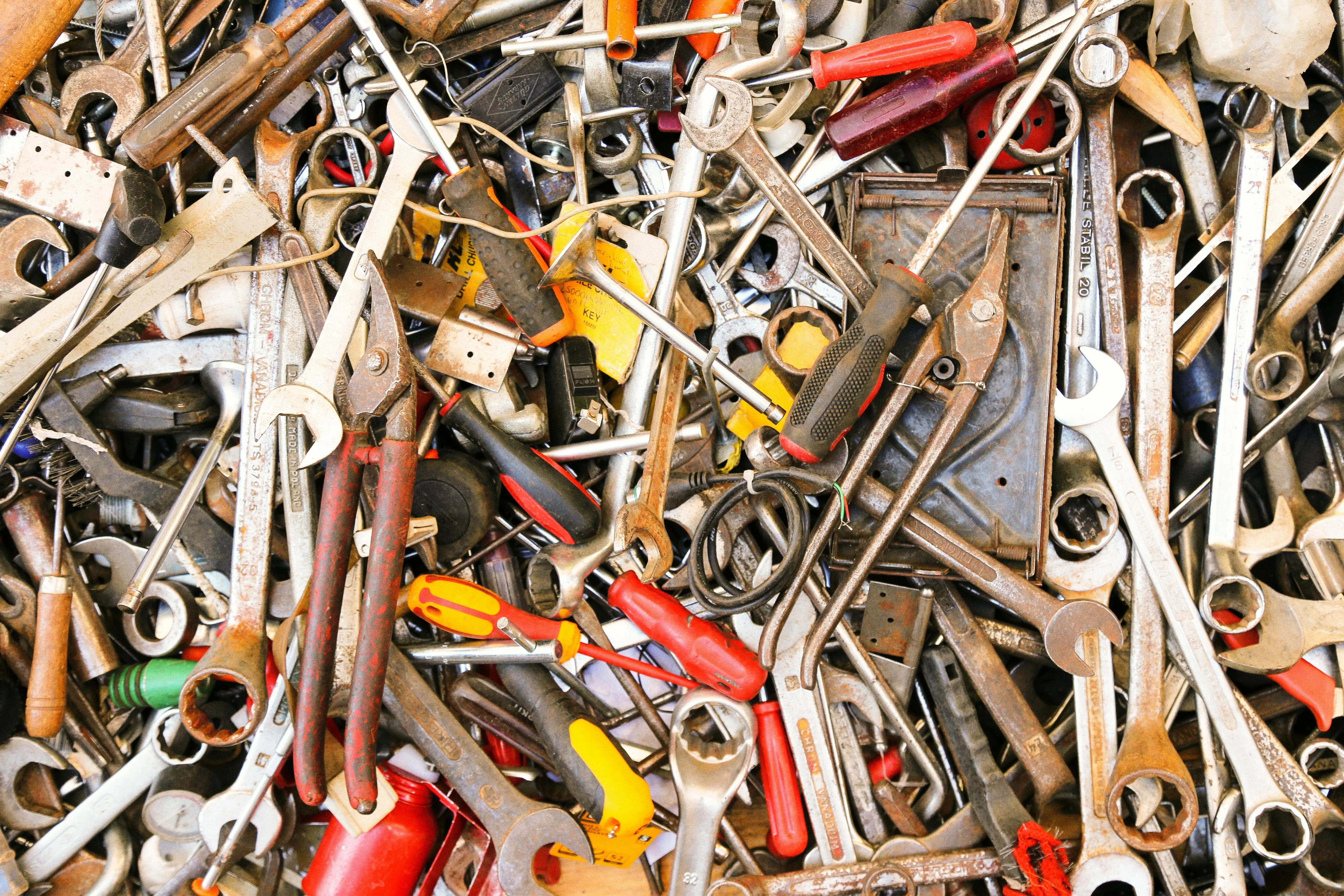
What AI Can (and Can’t) Tell You About That Old Tool in Your Barn
The short answer: yes — for most vintage tools, AI photo identification names the tool type in seconds and frequently the maker too, especially for documented brands like Stanley, Disston, and Millers Falls. Where it has limits is the genuinely obscure: one-off blacksmith work and dead-trade tools, where AI narrows the category and human collectors finish the job.
Last fall a reader sent us a photo that had been bouncing around her family group chat for a week: a heavy iron tool from her grandfather’s barn, shaped like oversized pliers with a flat beak. Her uncle said fencing tool. Her brother said farrier’s nippers. The group chat had settled, incorrectly, on “old bolt cutter.”
The AI called it in four seconds: a saw set — the tool that bends saw teeth alternately left and right so the blade doesn’t bind in the cut. Then it did something more useful than naming it: it flagged the visible “C. E. Jennings” stamp her family hadn’t noticed, which dated the tool to a defunct New York maker and put its value around $25–40.
That’s a fair picture of what AI tool identification is in 2026 — fast, surprisingly specific on marked and documented tools, and most powerful when it points your eyes at the details that matter. Here’s an honest accounting of how it works and where it ends.
How AI Photo Identification Actually Works
When you upload a photo to our identifier, several things happen in sequence, in a few seconds:
1. Visual feature analysis. A computer vision model reads the geometry — overall silhouette, proportions, the working surfaces, handle shape, material textures. This is the same category of model that powers face and object recognition, trained specifically toward tools. Shape carries enormous information: a plane body, a brace sweep, a froe’s right angle are unambiguous even under rust.
2. Text extraction (OCR). The system reads any visible stamps, etches, and castings — maker names, model numbers, patent dates. This layer is what turns “vintage hand plane” into “Stanley No. 5, likely Type 11–13.” On antique tools, a legible mark is worth more to the AI than the entire rest of the photo.
3. Contextual synthesis. The model combines shape, markings, materials, and wear patterns against what it knows about tool categories and makers, then produces an identification with a confidence level — plus usage history, era context, and value ballparks where the category is well documented.
The honest version of the magic: the AI has effectively seen more tools than any single collector ever will, but it has seen common tools millions of times and rare tools barely at all. That asymmetry defines exactly where it’s strong and weak.
Where AI Excels on Vintage Tools
Documented brands. Stanley planes, Disston saws, Millers Falls braces, Starrett instruments — these have deep photographic records, and identification regularly lands maker and model, not just type. Pair the result with a type study guide and you can often pin a manufacturing window.
Form-distinctive tools. Draw knives, froes, adzes, spokeshaves, bit braces, hay knives — tools whose shape is their identity. Even heavily rusted examples identify reliably because geometry survives corrosion.
The “what category is this” question. This is the underrated win. Most people holding a mystery tool aren’t one fact away from the answer — they don’t even know which shelf of the library to search. AI collapses that step from hours to seconds.
Marked tools with worn marks. OCR frequently reads stamps that eyes skip past, especially shallow stamps photographed in raking light. The saw set story above is typical: the mark was in the photo all along.
Where AI Hits Its Limits
Dead-trade and regional tools. A cooper’s croze, a wheelwright’s traveler, a specific pattern of tobacco knife used in one Kentucky county — training data is thin, and the AI may return a confident-sounding cousin instead. For these, the collector communities are still the authority.
Blacksmith-made one-offs. A tool forged by hand to one farmer’s need matches no pattern because there is no pattern. AI will read the function correctly (“a hooked cutting tool, likely agricultural”) without naming it, because it has no name.
Precise valuation. AI ranges are honest ballparks for documented categories. But the $40-vs-$400 difference in vintage tools lives in condition minutiae — etch percentage, original totes, pitting depth, replaced hardware — that requires eyes-on judgment. Identification is the AI’s job; final valuation against eBay sold listings is yours.
Bad photos. Still the number one cause of bad identifications, and entirely fixable.
Photographing Antique Tools for AI (and for Humans)
The same photos that help AI help every appraiser and forum you’ll ever ask. Four rules:
- Flat lay, top-down, neutral background. Cardboard, butcher paper, plain wood. Busy backgrounds genuinely degrade results.
- Raking light for marks. Hold a flashlight at a low angle across stamps and etches — shallow marks invisible head-on jump out in side light. Shoot the mark close-up as a second photo.
- Show the working position. Tools that pivot, clamp, or extend should be photographed open. The mechanism is often the identity.
- Include scale. A tape measure in frame, or just state the length. A 6-inch and a 26-inch version of the same silhouette are different tools.
The Workflow That Actually Works
After watching thousands of identifications run through the platform, the efficient sequence for any antique tool is:
- Photograph it properly (rules above) and run the AI — seconds, free, and it resolves the majority of pieces outright.
- If you get a maker and model: jump to the reference literature — Stanley type studies, Disston medallion guides — and then eBay sold listings for value.
- If you get a category but not a name: search that category’s collector vocabulary (now you know to search “saw set” and not “weird pliers”), and post to r/whatisthisthing or the EAIA forums with your good photos.
- If it might be valuable: slow down before cleaning anything. Original patina and intact marks are value; aggressive cleaning is how $200 tools become $40 tools.
The point isn’t that AI replaces the collector communities — it’s that it does the first 80% of their work in the first ten seconds, so the humans only get the genuinely interesting questions.
Frequently Asked Questions
Q: How accurate is AI on antique tools? A: Strong on recognizable forms and marked tools — type-level accuracy is high and maker-level identification is common for documented brands. Obscure trade tools drop to category-level accuracy, which still beats starting from nothing.
Q: Can AI tell me what my tool is worth? A: It gives honest ballparks for documented categories. Exact value depends on condition details that need human eyes — use AI to identify, sold listings to price.
Q: AI or Reddit — which should I use? A: Both, in that order. AI for the instant answer; r/whatisthisthing for whatever the AI can’t fully resolve. Your good photos serve both.
Q: Why does AI miss some old tools? A: Sparse training data on rare tools, unmarked hand-forged variation, and a century of wear changing the visual signature. Better photos recover a lot of this.
Q: Are my photos stored? A: On our platform uploads are processed and not kept permanently. Check any identification app’s privacy policy before uploading pieces you believe are valuable.