How to Identify a Vintage Hand Saw: Disston, Atkins & Simonds
The short answer: identify a vintage hand saw by reading three things — the medallion (the decorative fastener in the handle, which dates the production era), the etch (the maker’s marking on the blade near the heel), and the handle material and hardware. A Disston medallion reading “Henry Disston & Sons” with Philadelphia marks puts the saw after 1865; an elaborate multi-element etch means pre-WWII.
At a western Massachusetts tool swap a few years back, I picked up a hand saw from a dealer who’d priced it at $15. He thought it was a generic old saw. I looked at the medallion — a specific eagle design with “Henry Disston & Sons” and a Philadelphia city mark — and immediately knew I was looking at a pre-1900 Disston D-8 in rip configuration. The etch was partially intact on the heel. Original handle, probably applewood, with three split-nut screws.
I paid $15. Sold it six months later for $95 on eBay. Not a life-changing payday, but the point stands: reading a vintage saw correctly takes maybe two minutes once you know what to look for. Most people don’t look at all.
Here’s what to look for.
What Kind of Saw Is This?
Before you read the maker’s marks, identify the saw type. Knowing the type tells you what the tool was designed to do and sets the context for valuation.
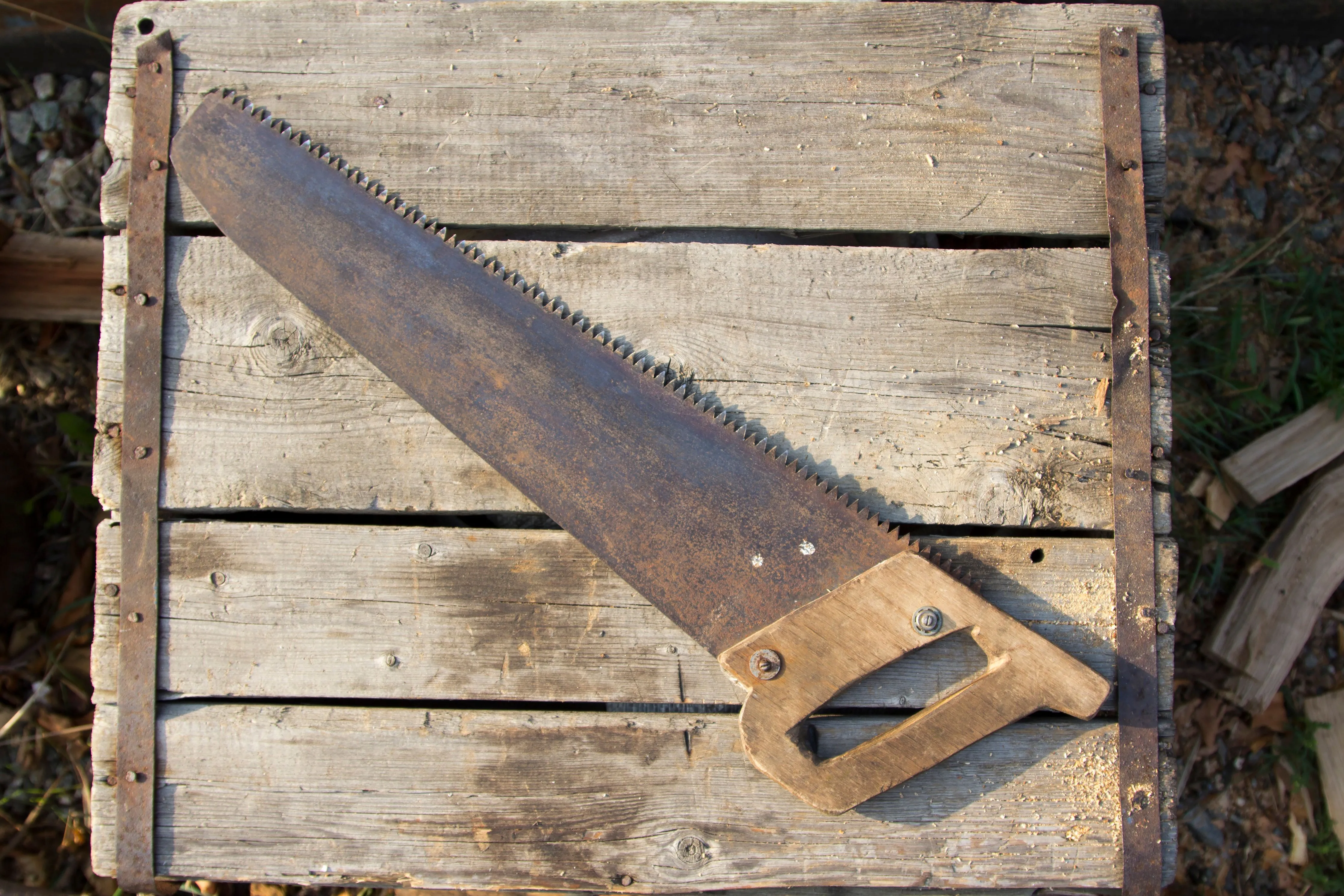
Panel saws / hand saws: The big crosscut and rip saws (20”–26” blade) most people picture when they think “hand saw.” These were the primary production cut tool before circular saws. Crosscut saws sever wood across the grain; rip saws cut with the grain.
How to tell rip from crosscut: Look at the tooth geometry. Crosscut teeth are filed at an angle (roughly 60–75° to the blade) with alternating bevels, designed to sever fibers. Rip teeth are filed straight across (perpendicular to the blade), shaped like tiny chisels, designed to pare away material. This matters because crosscut saws in good condition get more use from woodworkers today, while rip saws in excellent original condition can command a modest premium from collectors.
Tenon saws / back saws: Smaller saws (12”–16” blade) with a brass or steel spine along the back edge to keep the blade rigid. Used for joinery — cutting tenons, dovetails, and other precise joints. Disston made excellent back saws; the pre-1900 examples with brass spines and applewood handles are beautiful and functional.
Dovetail saws: The smallest back saws (8”–10”), fine teeth, designed specifically for cutting dovetail joints. Any vintage dovetail saw in good condition has real interest from woodworkers — they’re still excellent tools.
Reading the Maker’s Mark and Medallion
Every significant American saw maker stamped their name on the blade near the heel and used a medallion — a decorative metal fastener through the handle — as a visual brand mark.
Where to look: The maker’s name or stamp appears on the blade near the heel (the end with the handle) and sometimes runs the full length of the blade as an “etch” — a decorative chemical or mechanical stamp. The medallion is the fastener through the handle’s grip area; it’s both functional (holding the handle to the blade) and decorative.
Disston
Disston is the most collected American saw maker. Henry Disston founded the company in Philadelphia in 1840, and they dominated American saw production for over a century.
The medallion is the fastest dating tool. Disston medallions went through several design evolutions:
- Pre-1865: Simple eagle designs, relatively plain. Very early examples are rare.
- 1865–1878: The “Sons” period begins. “Henry Disston & Sons” on the medallion.
- 1878–1917: The H.D.&S. period. More elaborate eagle designs, often with the Keystone Works reference (their factory).
- 1917+: The company name changes reflected ownership transitions.
The “D-number” on a Disston saw (D-8, D-15, D-23, etc.) refers to the model designation, not the teeth per inch or the length. The D-8 was their flagship production model — common as rain and widely available. The D-15 was a higher-quality grade. The D-23 was their economy line.
Split-nut screws (the fasteners through the handle) also give dating clues. The earliest Disstons used a simple nut. Later production introduced the decorative split-nut style. Handle material transitions from applewood to beech to later materials as production periods change.
Atkins
The E.C. Atkins Company operated out of Indianapolis. Their signature is the “Silver Steel” marketing — Atkins advertised their premium steel grade extensively on blade etches and packaging. The etch typically reads something like “E.C. Atkins & Co. Manufacturers Indianapolis Ind. Silver Steel Warranted.”
Atkins saws are somewhat less collected than Disston but often have better surviving etches because they used a heavier etch application. A clear Atkins etch is genuinely beautiful.
Simonds, Spear & Jackson, Tyzack
Simonds (Fitchburg, MA): Made both saws and files. Simonds saws are good quality, less deeply collected, and often underpriced at estate sales.
Spear & Jackson (Sheffield, England): You’ll encounter these more often than you’d expect in North American estates, particularly in areas with British immigrant populations. High quality, British manufacture, distinctive Sheffield markings. The S&J name is still in use on modern tools but old examples with the full “Est. 1760” Sheffield markings are collectible.
Tyzack (Sheffield): Another Sheffield maker. Less known in North America but excellent quality.
Reading the Etch
The etch — the decorative marking along the blade near the heel — is the most visually impressive part of a vintage saw and one of the most useful for identification.
Elaborate, multi-detail etches mean pre-1940s manufacture. The early Disston etches in particular are lithographic masterpieces: eagle imagery, factory scenes, elaborate script, multiple colors in the better examples. If you have a saw with a complex, multi-element etch, you’re looking at pre-WWII production.
Missing etch doesn’t mean early. This is the most common mistake. Etches wear off through use. A saw that was used hard in a workshop for 30 years might have a completely blank blade by 1950, even if it was made in 1895. Absence of etch tells you nothing about age — you have to read the medallion and handle separately.
Condition of surviving etch matters for value. A pre-1900 Disston with 70% of the elaborate etch intact is worth significantly more than the same saw with the etch completely worn. The etch doesn’t affect cutting performance but matters enormously for collector value.
Handle Wood and Hardware
Handle material is one of the most reliable dating indicators:
Applewood: Used by premium makers for their best models through the early 20th century. Hard, dense, and beautiful. If you have a handle with fine straight grain and a reddish-brown tone that’s noticeably harder than the beech on common saws, it’s likely applewood. This indicates either early (pre-1900) production or a premium model.
Rosewood: Used by Disston and others on their finest production. Deep reddish-brown, heavy, strong grain. Rosewood handles on saws usually mean quality production — either pre-1920 or a high-grade model designation.
Beech: The common production-grade material. Most post-1900 production saws use beech. It’s fine functionally but signals standard production rather than premium.
Carved vs. pressed handles: Earlier handles were carved from solid stock. Later production used pressed handle blanks. The pressed handles are usually thinner in the cross-section and have a slightly different grip feel.
Sharpen It or Replace It?
This is the practical question for anyone who finds a vintage hand saw.
Worth sharpening if:
- The plate (blade) is straight — no kinks or bends
- The teeth have even spacing and roughly uniform height (can be jointed and filed to evenness)
- The handle is solid, even if it needs a light cleaning
- The set (the sideways bend of the teeth) is roughly equal on both sides
Sharpening a hand saw is a skill worth learning — file, jointing tool, saw set. An experienced person can bring most user-grade Disstons back to full cutting performance in an hour. The result is often a better-cutting saw than anything under $100 sold new today.
Not worth sharpening if:
- The plate has significant kinks or bends (a kinked saw plate can’t be straightened effectively at home)
- The teeth are filed down so far that re-filing would leave them too short to be useful
- The handle is split through the grip area (functional problem, not just cosmetic)
If you need a new saw, the modern options are genuinely good. Japanese pull saws cut faster than Western saws and don’t require sharpening knowledge to maintain (the blades are replaced, not sharpened). For Western saw enthusiasts, the Spear & Jackson 22” panel saw is the entry-level option worth buying.
What’s It Worth?
Honest ranges based on current eBay sold listings:
Common Disstons (D-8, D-15) in user condition: $20–$45. These are the most frequently encountered and the least valuable in typical condition.
Pre-1900 Disston with intact etch: $60–$200 depending on etch condition and handle completeness.
Rare Disston medallion styles (early eagles, specific city variants): $100–$400 for exceptional examples.
Panel saw in complete, excellent condition (full etch, applewood handle, all split-nuts original): $150–$350.
Back saws and tenon saws (Disston or Atkins) in good condition: $30–$120. The woodworking community actively uses these — they’re tools as well as collectibles.
Dovetail saws in fine condition: $50–$150. High demand from both collectors and active woodworkers.
Frequently Asked Questions
Q: How do I date a Disston saw without the etch? A: Focus on the medallion design and handle screws. The medallion design evolution (eagle style, text around the edge) is well documented in collector references like the EAIA publications. The split-nut screw style also changes across production eras.
Q: Is a Disston D-8 with a plastic handle worth anything? A: Very little for collector purposes — $15–$25 in working condition. Plastic handles indicate post-WWII production, after the company had declined from its golden era.
Q: Can I identify a saw that has no markings at all? A: Often yes, based on tooth geometry, plate thickness, handle style, and hardware. Post your photos to r/handtools or r/whatisthisthing — the community is remarkably good at identifying unmarked tools.
Q: Are saw filing skills difficult to learn? A: The basics are learnable in an afternoon. You need a saw file (appropriate size for the teeth per inch), a saw set tool, and a joining file or diamond paddle. The EAIA and numerous YouTube channels cover the process in detail.
Q: What’s the difference between a rip saw and a crosscut saw for buying purposes? A: In terms of value, crosscut saws are more in demand from woodworkers because most modern cutting is across the grain. Rip saws in fine condition can be slightly more valuable to collectors because fewer were preserved in excellent shape. For practical use, crosscut wins.