What Is This Old Hand Plane? A Complete Stanley & Bailey Identification Guide
The short answer: find the model number cast into the body or stamped on the blade (Stanley bench planes run No. 1 through No. 8 by size), then date it by type-study features — frog adjustment screw, lateral adjuster shape, the Sweetheart logo, and handle wood. Patent dates on the casting are minimum-age anchors, not manufacture dates. Most No. 4s and 5s are worth $20–$60; the rarities run to $2,000+.
Three Saturdays ago I paid $8 for what looked like a rusty scrap of iron at a New Hampshire estate sale. Cracked tote, missing the cap iron, pitted blade. The seller had it priced with a collection of random hardware — nuts, bolts, a broken hinge. I didn’t say anything. I just paid and left.
Back home under a light, I cleaned the surface rust with a wire brush and some Evapo-Rust. The lateral adjuster came into focus first, then the frog adjustment screw. Stanley No. 2, Type 9. Made somewhere between 1902 and 1907. A replacement tote costs $20 on eBay. A reproduction cap iron costs $15. Clean example of that plane, properly restored, sells for $180–$250 on a good day.
I paid $8 because the seller didn’t know what it was. That’s how this works.
Hand planes are the most studied category in vintage tool collecting — there’s more written about dating and valuing Stanley planes than almost any other American tool. Once you know how to read one, the identification takes minutes.
First Look — Is It Actually a Hand Plane?
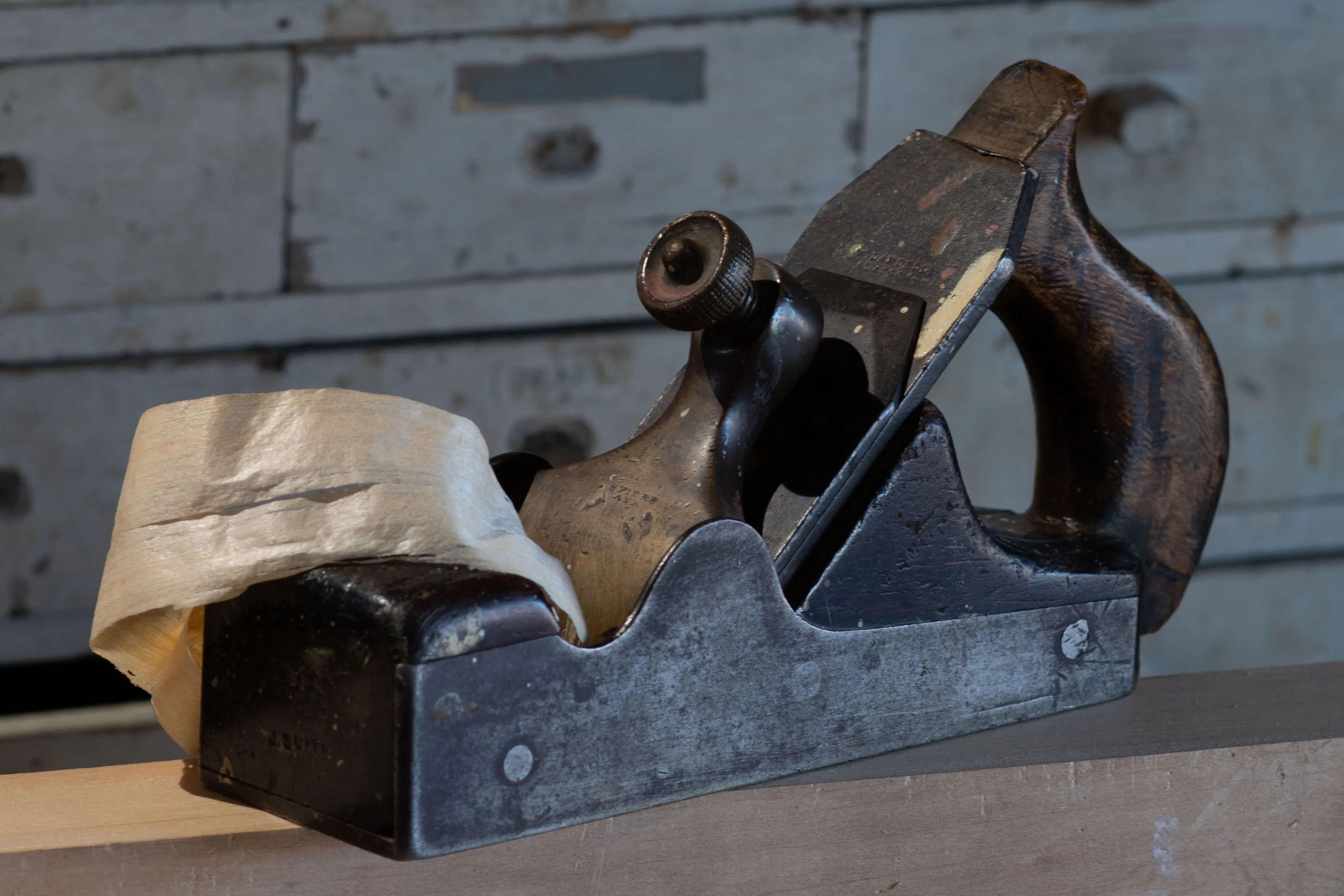
A hand plane is a blade held at an angle in a metal or wooden body, used to shave wood flat and smooth. The blade is exposed at the bottom of the body through a slot called the mouth. You push the plane across wood and thin shavings curl up through the mouth opening.
The three plane families:
Bench planes are the most common — what most people picture when they think “hand plane.” Flat sole, blade set at roughly 45 degrees. Used for flattening, thicknessing, and smoothing wood. They’re numbered by size (No. 1 through No. 8 in the Stanley system, with No. 1 being the smallest).
Block planes are smaller, held in one hand, with the blade set at a lower angle (12-20 degrees). Used for end grain work, chamfers, and detail tasks. Stanley’s most common are the No. 9½ and No. 60½.
Specialty planes were made for specific tasks: the No. 45 combination plane for moldings and grooves, the No. 71 router plane for cleaning out dadoes and mortises, the No. 78 rabbet plane for cutting rabbets along edges.
If you have a large, two-handed tool with a flat bottom and a blade sticking up at roughly 45 degrees, you have a bench plane. Start there.
Reading the Numbers — No. 1 Through No. 8
Stanley’s bench plane numbering system is based on size. It’s not random.
| Number | Length | Weight | Primary Use |
|---|---|---|---|
| No. 1 | 5½” | 2 lb | Collector’s item — too small for practical use |
| No. 2 | 7” | 2.5 lb | Small smoothing, tight spaces |
| No. 3 | 8” | 3.5 lb | Smoothing plane, small stock |
| No. 4 | 9” | 4 lb | The most common — general smoothing |
| No. 4½ | 10” | 5 lb | Wider version of the 4 |
| No. 5 | 14” | 5.5 lb | The jack plane — the workhorse |
| No. 5½ | 15” | 6.5 lb | Wider jack |
| No. 6 | 18” | 7 lb | Fore plane — flattening long boards |
| No. 7 | 22” | 8.5 lb | Jointer — truing long edges |
| No. 8 | 24” | 10 lb | Large jointer |
The No. 4 is by far the most common Stanley plane you’ll encounter. It was their bread-and-butter production tool for decades, made in enormous quantities. This abundance means common No. 4s in user condition sell for $15–$50 — they’re not rare. Don’t overpay for a rusty user-grade No. 4 because someone put “antique” in the eBay title.
The No. 1 is the rarity. Stanley made relatively few of them — they’re impractical for woodworking, but collectors love them for the completeness of a set. Clean examples sell for $800–$2,000+.
Block planes don’t use the same size-based numbering. The key models:
- No. 9½: Standard-angle (20°) block plane. The most common.
- No. 60½: Low-angle (12°) version. Better for end grain. More popular with woodworkers today.
- No. 18: Knuckle-joint lever cap version. Unusual mechanism, recognizable if you know it.
- No. 110: The cheap production block plane. Single adjustment, no lateral. Common and not particularly collectible.
The Maker’s Mark — Stanley, Bailey, Sargent, Sweetheart
Stanley vs. Bailey confuses almost every new collector. Here’s the simple version: Bailey is the name of the design, not a separate company. Leonard Bailey invented the adjustable bench plane design in the 1860s and sold his patents to Stanley Rule & Level Co. Stanley then produced planes using Bailey’s patented mechanisms, stamping them “Stanley Bailey” or just “Stanley.” They’re the same company.
The Sweetheart era (roughly 1920–1935) is a useful dating marker. During this period, Stanley used a logo that featured a small heart between “S W” (the initials of the Stanley Works). Blades from this period are stamped with this heart logo. Collectors call it “Sweetheart” and these tools generally have a slight premium because the steel quality was high during this period.
Other makers you might find:
- Millers Falls: Made excellent planes, slightly less collected than Stanley, often underpriced. The No. 9 is comparable to Stanley’s No. 4.
- Sargent: Long-running Hartford, CT maker. Good quality, different blade system, not as deeply type-studied as Stanley.
- Ohio Tool Company: Planes often sold under hardware store brands. Good tools, less collector attention.
- Record (UK): You’ll find these more often than you’d expect in North America. Similar to Stanley designs but British manufacture. Their “0 series” planes are excellent users.
Patent Date vs. Manufacture Date (The #1 Collector Mistake)
The casting or blade of a Stanley plane might read “Pat’d Oct 3 1882” or “Pat. 3.22.92” — a list of patent dates going back decades. This does not mean your plane is from 1882.
Patent dates are minimum-age anchors. The plane cannot be older than the newest patent date listed. But it could have been made 30 years after that patent was issued, with the date cast into the body because the company never updated the casting.
The way to actually date the plane is through type study features — the specific combination of design characteristics that researchers have mapped to production years.
Dating a Stanley by Type Study Features
Patrick Leach’s “Blood and Gore” — a meticulous type study guide freely available online — is the collector bible for Stanley planes. It maps 20 “types” of Stanley bench planes to approximate production years based on specific feature combinations.
You don’t need to memorize all 20 types to do basic identification. Six features narrow it quickly:
1. Frog adjustment screw: Present or absent. The frog adjustment screw (on the back of the frog casting, used to move the frog without disassembling the plane) first appears in Type 11 (around 1910). If there’s no frog adjustment screw, the plane predates 1910.
2. Lateral adjuster shape: The lateral adjuster (the disc that moves the blade sideways) changes shape across types. Early adjusters are simple round discs; later types have a more complex shape with a keyhole slot.
3. Sweetheart logo: If the blade carries the SW heart logo, the plane dates to 1920–1935 (approximately). After 1935, Stanley stopped using the Sweetheart mark.
4. Tote and knob material: Rosewood indicates pre-1940s quality manufacture. Beech is more common in mid-century production. Yellow-painted wood or synthetic material indicates post-WWII.
5. Casting quality and weight: Pre-war castings are generally heavier and higher quality. Post-war castings are lighter and sometimes have a rougher texture.
6. Kidney hole in the cap iron: Stanley’s cap irons went through design changes. The kidney-shaped hole appears in later types.
These six checkpoints get you within a decade for most planes. For precise dating, cross-reference with Leach’s full type study.
What Is It Worth?
Honest market reality: most Stanley bench planes are worth $15–$80 in user condition. The collector premium only appears on specific models and specific conditions.
The common ones (No. 4, 5, 6): A No. 4 in user condition (some surface rust, functional, all parts present) is worth $20–$45. A clean, complete, Sweetheart-era No. 4 might hit $60–$80. An exceptional No. 4 in original box is $150+, but that’s unusual.
Mid-range collectibles: The No. 3 and No. 7 have a collector following beyond their user value. Nice No. 7s sell for $60–$120. The No. 8 is heavy and less useful for woodworking but commands a premium: $80–$180 for clean examples.
The rarities: Stanley No. 1 — $800 to $2,000+, clean examples can exceed that. Stanley No. 2 in good shape: $150–$350. Stanley Bedrock planes (the premium line with a different frog attachment) command 2-3x the equivalent Bailey price.
Specialty planes: The No. 45 combination plane in complete condition with all cutters is $150–$400 depending on age and completeness. The No. 55 (the ultimate combination plane) in complete original box: $500+.
Restoring vs. Replacing — Modern Alternatives
Not every old Stanley is worth restoring. Here’s a framework:
Restore if: The plane is complete or nearly complete, the blade is salvageable (not pitted through, can be flattened on the back and re-beveled), and the tote and knob are original and intact (or you can find replacements). A No. 5 or No. 7 in user condition restored properly is a fine working tool — often better steel than new budget planes.
Replace if: The blade is pitted through (pitting that goes through the back of the blade can’t be flattened away), the casting is cracked, or the tote and knob are missing and the model is too common to make replacement parts cost-effective.
Modern alternatives worth knowing:
- Wood River (Woodcraft): Made in China but to respectable quality specifications. The No. 4 runs around $120 and is a solid user plane for beginners.
- Lie-Nielsen: Premium American-made planes ($200–$400). If you’re serious about hand planing, these are what experienced woodworkers buy.
- Veritas (Lee Valley): Canadian-made, extremely well-engineered, excellent blade steel. Similar price tier to Lie-Nielsen.
If you have a vintage Stanley that you’re not sure is worth restoring, the practical question is: what would a comparable new tool cost? For the No. 4, a new Wood River is $120. If your vintage restoration costs $80 in parts and time, the vintage tool makes sense only if you enjoy the restoration process or have a particularly nice example.
Frequently Asked Questions
Q: What’s the difference between Stanley Bailey and Stanley Bedrock planes? A: The Bedrock line (No. 602–608) uses a different frog attachment than the Bailey line. The Bedrock frog sits in a machined channel and makes lateral adjustment slightly smoother and more stable. Stanley charged more for them; collectors pay 2–3x the Bailey equivalent price today. Functionally, the difference is minor for most woodworking.
Q: My Stanley has “Made in England” stamped on it — is that worth less? A: Stanley UK planes are generally worth somewhat less to American collectors, since the type study work focuses on American production. The tools themselves are often equivalent quality. UK Stanleys are common in Canada and the northeastern US from hardware store imports.
Q: Can I use a vintage Stanley plane straight out of the estate sale? A: With some cleanup, usually yes. Flatten the back of the blade on a diamond plate, sharpen the bevel, clean the sole with a wire brush and light oil, and you should have a working tool. The main exception is if the blade is pitted — surface rust cleans off, but pitting that goes through the back can’t be lapped away.
Q: What’s the easiest way to identify a block plane model number? A: Turn it over and look at the casting on the bottom. Most Stanley block planes have the model number cast into the base. The No. 60½ says “60½” right on the casting. If the number is worn off, the blade angle (standard vs. low) and the lever cap style are the best differentiators.
Q: Where’s the best place to buy replacement parts for a vintage Stanley? A: Hyperkitten Tool Company has the best selection of vintage Stanley replacement parts. For new-manufacture replacement totes and knobs, both Lie-Nielsen and Woodcraft sell compatible parts.