What Is This Old Tool? A Practical Guide to Vintage and Antique Tool Identification
The short answer: start with what the tool was built to do — the shape gives away the function — then hunt for maker’s marks near the working end or handle, and use patent dates as the earliest-possible age. Half of pre-1920 tools carry no marks at all, which is when construction details (hand-forged vs. cast, handle material, hardware style) do the dating instead.
I found it buried under a pile of paint-stiffened drop cloths at an estate sale in rural Pennsylvania — a chunky cast iron thing with a wooden tote that had split halfway up, a frog that sat at a strange angle, and absolutely no visible markings. The guy running the sale wanted three dollars for it. I handed him a five and didn’t wait for change.
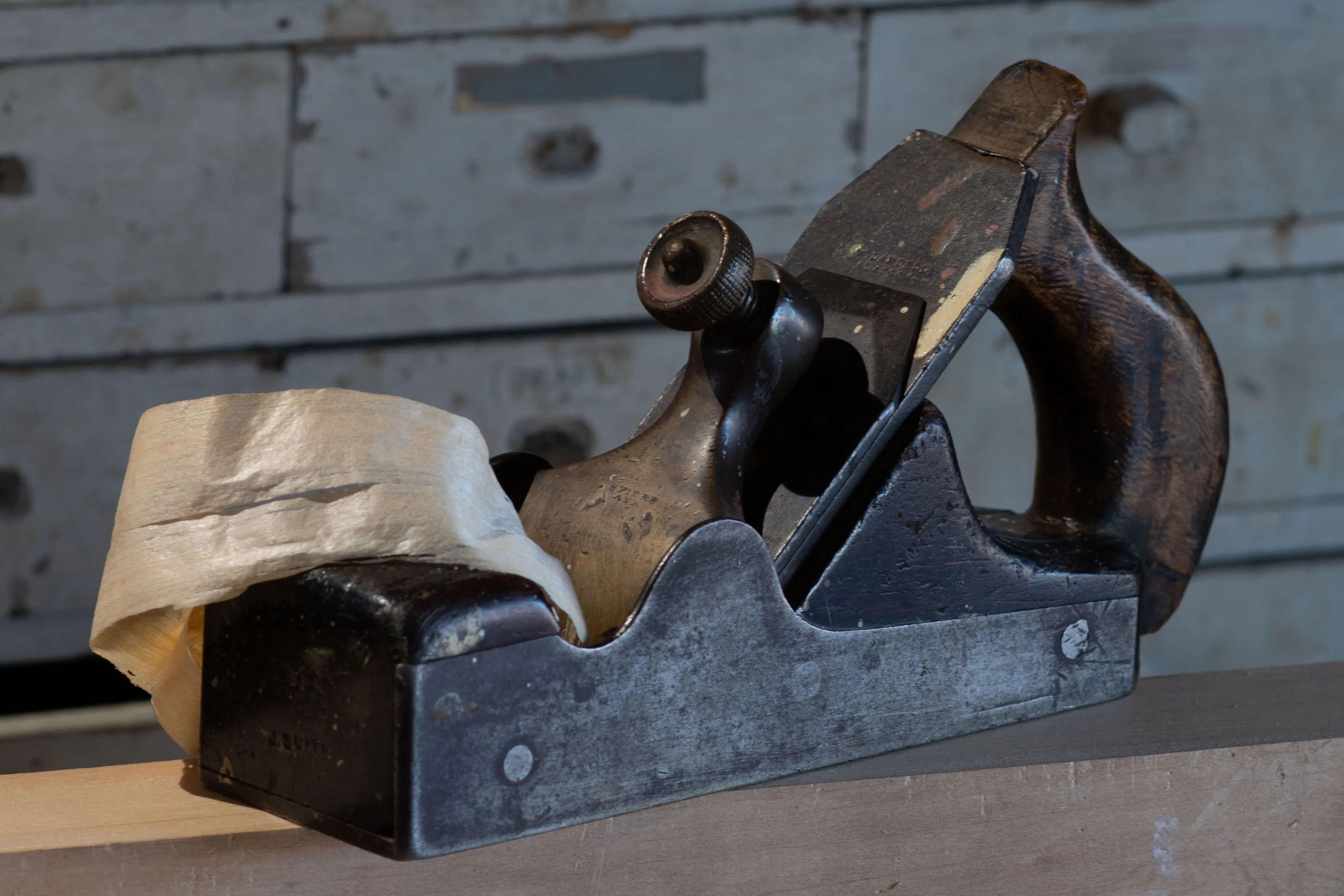
Two weeks later, after a lot of squinting at casting marks and cross-referencing with Patrick Leach’s type study, I figured out it was a Stanley No. 4 from somewhere around 1895–1902. Not a screaming rarity, but a genuinely nice early-type plane. Worth real money cleaned up. More importantly, it worked beautifully once I flattened the sole and honed the blade.
That’s the thing about old tool identification — it’s one part detective work, one part history lesson, and one part gambling. Sometimes the crusty lump you paid nothing for turns out to be something special. Sometimes the thing that looks impressive is a late-production wall hanger you couldn’t give away at a swap meet.
This guide is for everyone who has picked up a mystery tool and thought: what is this old tool, and what do I do with it?
Why Identifying Old Tools Is Different
Modern tool identification is mostly easy. There’s a brand name on it, maybe a model number, and if there isn’t, you can describe its function and figure it out in about thirty seconds. Old tools don’t work that way.
For starters, pre-war tools weren’t labeled for collectors. Nobody in 1885 was stamping a detailed provenance onto their planes because nobody imagined people a hundred and forty years later would be trying to figure out where they came from. Maker’s marks were stamped on blades or cast into bodies, and they could be small, ambiguous, worn flat, or completely absent. The problem with pre-1920 tools is that half of them weren’t marked at all. Regional manufacturers built tools in short runs. Small hardware stores sold “house brand” tools made by whoever was cheapest that season. A tool marked “WARRANTED CAST STEEL” tells you almost nothing except that someone, somewhere, at some point, wanted you to think the steel was decent.
Then there’s the hand-forged variation problem. A blacksmith in rural Ohio making chisels in 1840 wasn’t following a spec sheet. He was making what he knew how to make, by eye and feel. Two chisels from the same shop could differ noticeably in profile, weight, or grind. This drives people crazy when they’re trying to match a tool to a known example.
Regional variations compound the confusion. American and British tools from the same era often look like they come from different planets. European joinery planes are typically narrower and longer. British planes use a different blade bedding angle. German chairmaking tools have profiles you won’t find in any American catalog. If you’re doing vintage tool identification and only looking at American references, you’ll misidentify a lot of imported tools.
And then there’s patina, modifications, and creative repairs. Craftspeople used their tools hard and fixed them when they broke. A repaired tote doesn’t make a plane less valuable, but a replaced blade or a re-ground sole absolutely affects both identification and value. You have to learn to read what’s original and what’s been touched.
Reading Maker’s Marks and Patent Dates
Once you understand that maker’s marks can be tricky, you can start reading them systematically.
Where to Look for Maker’s Marks
On planes, check the blade first. The manufacturer usually stamped the iron with their name and sometimes a patent date. The frog — the cast iron wedge-shaped casting that holds the blade assembly — will sometimes have casting marks on the back face. The body itself may have a model number cast into it or stamped underneath.
On saws, look at the etch on the blade, near the heel (the end closest to the handle). This is where makers put their logo, patent info, and sometimes the model designation. Disston saws have some of the most legible and informative etchings in the business. The handle itself may be stamped on the medallion — that decorative screw in the middle of the handle.
On chisels and plane irons, the stamp is almost always on the flat face of the blade, near the top. Look for it in raking light — hold the tool at an angle to a light source. Worn stamps reveal themselves far better in raking light than under direct illumination.
Braces and drills often have the manufacturer’s name cast into the frame or stamped on the chuck. Egg-beater drills frequently have a small plate or cast name near the handle.
How Patent Dates Actually Work
This is the most common mistake in antique tool identification, and it trips up even experienced collectors.
A patent date stamped on a tool is a minimum age, not a manufacture date. When Stanley stamped “PAT. MARCH 25, 1884” on a plane, that meant the design had been patented on that date. They kept using that stamp for years — sometimes decades — after the original patent. A tool stamped with an 1884 patent date might have been made in 1884. It might also have been made in 1906.
What patent dates do tell you is that the tool can’t be older than that date. If you find a plane stamped with a patent from 1890, you know it was made no earlier than 1890. That’s useful. It just doesn’t tell you the actual manufacture year.
To nail down the actual production period, you need to look at a combination of features — the blade stamp, the casting style, the japanning (that black enamel finish on the metal parts), the wood species and finish on the tote and knob, and how all those features line up with known type studies for that particular tool.
Also watch out for tools that have multiple patent dates. Stanley planes commonly carry three or four patent dates from different design improvements made over the years. The presence of all those dates on one plane tells you the tool was made after the most recent date on the blade — but that’s still just a floor, not a ceiling.
City Names and What They Tell You
When a tool has a city of manufacture, that’s genuinely useful information. “New Britain, Conn.” on a Stanley tool tells you it was made at their original Connecticut facility. If you see “New Haven” on a Winchester tool, or “Meadville, Pa.” on a Greenfield tap or die, these city names help you correlate with company histories.
Companies moved, merged, and were acquired. If you see a brand name that didn’t operate in the city named, you either have a misidentification or a transitional piece made during an acquisition period. Both situations are interesting in their own right.
British tools will often carry city names like Sheffield, Birmingham, or London. Sheffield was the center of edge tool manufacture — chisels, plane irons, saw blades. If you’ve got a high-quality old chisel and the city name is Sheffield, that’s good provenance regardless of whether the specific manufacturer is identifiable.
Casting Numbers and What They Reveal
Stanley and other major manufacturers cast model numbers directly into the bodies of planes and other tools. On a Bailey-pattern bench plane, you’ll find the model number cast into the toe (front) of the body, often on the side. A No. 4 will say “No. 4.” Simple enough. But here’s where it gets interesting.
On early planes, these numbers were cast in different styles — the font, the depth of the casting, the presence or absence of a decimal point all changed over production runs. Collectors who do serious type study learn to read these details like a fingerprint. The casting quality itself tells a story: early Stanleys have crisper, deeper castings; later production pieces are sometimes notably shallower and less precise.
Also check the underside of the plane body, below the mouth. This area was sometimes used for foundry marks or batch numbers that don’t appear in any official catalog documentation, which is part of why type study is such a rabbit hole.
Dating Tools by Era
Even without a maker’s mark, a tool’s construction tells you a lot about when it was made.
Pre-1860: Hand-Forged and Transitional
Tools made before roughly 1860 are almost entirely hand-forged or hand-finished. You can see this in the hammer marks, the slight irregularities in cross-section, the way the metal was shaped rather than machined. Chisels from this era often have octagonal handles secured with a hoop, hand-filed bevels, and surfaces that carry the marks of individual craftsmanship.
Joinery planes from this period — infill planes, wooden-bodied planes, transitional planes — are genuinely beautiful objects. A well-made wooden joinery plane from 1840 will have a body shaped from a single piece of carefully selected beech or apple, a wedge-secured blade, and proportions that feel different from anything made after industrialization. These tools weren’t cheap when new. A cabinetmaker’s set of planes represented a serious investment.
If you find something that looks this old and this well-made, treat it carefully. Don’t clean it aggressively, don’t put it on a grinder, and get a second opinion from someone who specializes in pre-industrial tools before you do anything else.
1860–1920: The Golden Age of American Tools
This is the era most collectors are working in, and for good reason. The period from roughly 1860 to 1920 is when American toolmaking hit its peak — mechanized production, serious metallurgy, intense competition between manufacturers, and enormous demand from a country that was building everything at once.
Stanley was founded in 1843 but really hit its stride after the Civil War. Leonard Bailey’s patents from the 1860s created the design language that still defines what a bench plane looks like today. Disston was already the dominant saw maker by the 1870s. The Millers Falls company was cranking out braces and drills. Greenfield Tool Company in Massachusetts was making taps and dies that were as good as anything in the world.
Tools from this era have excellent metallurgy, clean castings, and a fit and finish that reflects genuine pride of manufacture. The japanning on a well-preserved Stanley from 1895 still looks like it was applied yesterday. The blades hold an edge in a way that modern offshore steel often doesn’t.
The flip side is that this was also the period of the most complex type variations. Stanley alone made over twenty identifiable type variants of their bench planes between 1869 and 1961. Dating a tool to within a decade requires knowing which features appeared in which years.
1920–1960: Mass Production and Standardization
After World War One, the toolmaking industry consolidated significantly. Smaller regional makers were absorbed by larger companies. Production became more standardized, which meant less variation — but also less of the craftsmanship that characterized earlier work.
Tools from this era are still excellent — often better than anything made today at equivalent price points — but they’re not as interesting to collectors because the variation is less pronounced. A Stanley No. 4 from 1935 is a fine tool. It just doesn’t have the character of a No. 4 from 1895, and it’s not as rare.
Post-war tools (1945–1960) start showing some of the quality compromises that would accelerate later. Thinner castings. Cheaper handle wood. The japanning starts thinning out. Stanley shifted some casting production and the tolerances loosened slightly. You can still find great tools from this period, but you need to inspect them more carefully.
1960s Onward: When Quality Started Declining
This is when things get genuinely depressing if you care about tool quality.
By the mid-1960s, offshore competition was real, labor costs had risen, and American toolmakers were under serious margin pressure. The responses varied — some raised prices and maintained quality, some cut corners and maintained price points, and some just slowly let quality slide.
Stanley began moving production around, simplified some designs, and started using different (generally inferior) steel formulations. The japanning got thinner and less durable. Handle wood quality dropped. By the 1970s, a new Stanley plane off the shelf was a noticeably different animal from a 1910 Stanley, and not in a good way.
This doesn’t mean all post-1960 tools are garbage. Some American manufacturers held the line on quality well into the 1970s and even 1980s. But this is also when you need to be most careful about tools that look like quality pieces but are actually later production dressed up in familiar styling.
The Most Commonly Misidentified Vintage Tools
Stanley Bench Planes (The Rabbit Hole Everyone Falls Into)
If you inherit an old wooden-handled cast iron plane and ask any tool collector what it is, prepare to spend the next forty-five minutes hearing about Stanley type studies.
First: understand what you have. Bailey-pattern bench planes come in numbered sizes from No. 1 (tiny, rare, expensive) to No. 8 (large jointer plane, impressive, common). The No. 4 smoothing plane and No. 5 jack plane are the most commonly found. When someone says they have “a Stanley plane,” they usually mean one of these.
The difference between a block plane and a bench plane is the blade angle. Block planes have the blade bedded at a low angle (around 20 degrees), usually bevel up. Bench planes have the blade bedded at around 45 degrees, bevel down. Block planes are small, one-handed tools used for trimming end grain. If the plane is small enough to fit in one hand and has no tote, it’s probably a block plane.
Identifying early vs. late types requires knowing what to look for:
The frog is the cast iron casting that holds the blade assembly. Early frogs (pre-1902, roughly) have a different profile and mounting arrangement than later ones. The “frog seat” — the machined surface in the body where the frog sits — changed in shape over production runs.
The blade stamp changed regularly. Pre-1892 Stanley blades use a different logo than post-1892. The shield shape changed. The text layout changed. Collectors have catalogued these in excruciating, wonderful detail.
The japanning on early planes was applied more generously and has a particular depth and sheen. Late production japanning is often thin and flaky.
The tote and knob wood went from rosewood (prized) to walnut to a lighter beech-like wood in later production. Original rosewood totes on pre-1910 planes are a good sign.
The Stanley No. 1 is the Holy Grail — the smallest production plane Stanley made, extremely rare, worth $800–$2,000 in good original condition. The No. 2 is rare but less mythologized. The No. 3 is uncommon but findable. The No. 4 and No. 5 are everywhere. The “Liberty Bell” plane — a commemorative piece from the 1876 Philadelphia Centennial Exposition — is one of the rarest Stanley collectibles in existence.
The early No. 45 combination plane is another rabbit hole. The later No. 45 is a fine tool and reasonably findable. The very early Type 1 versions with specific fence and depth stop configurations are much harder to find and notably more valuable.
Braces, Bits, and Egg-Beater Drills
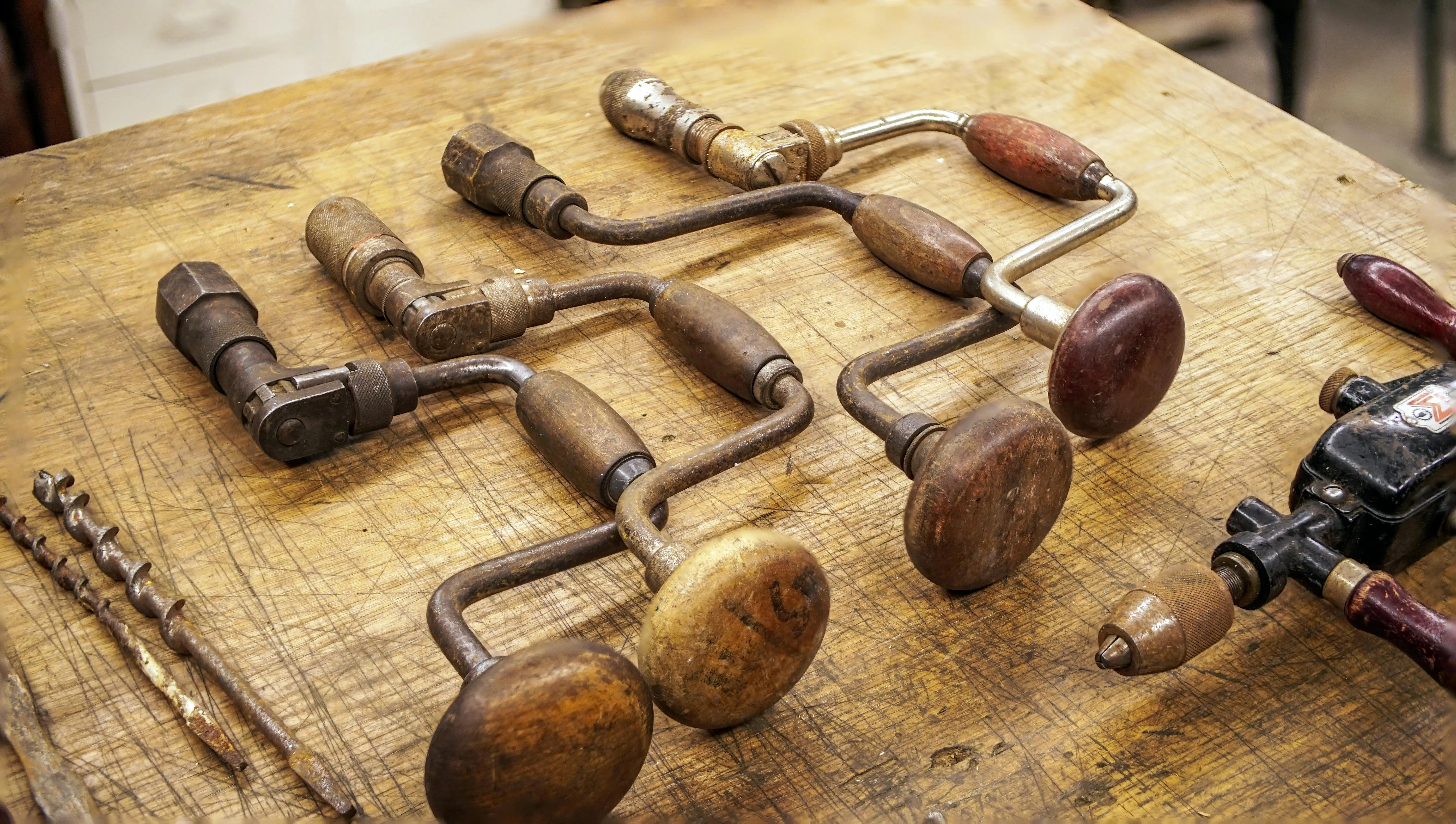
The hand brace — that U-shaped swept handle with a chuck at the bottom — was the primary hole-boring tool before electric drills. If you find one, it’s almost certainly from before 1960. Good ones came from North Brothers, Millers Falls, Stanley, and a dozen smaller manufacturers.
Identifying the maker usually requires finding the name on the chuck or stamped into the frame. The quality of the chuck mechanism is a good proxy for overall quality — a smooth, well-toleranced ratchet mechanism indicates a better tool.
Egg-beater drills (the two-handed wheel-driven type, not the swept-handle brace) were made by Millers Falls, North Brothers, and others. The North Brothers “Yankee” brand is the one people most often find and most often can’t identify.
Speaking of which: the Yankee spiral ratchet screwdriver is one of the most commonly found and most commonly unrecognized tools in old workshops. It looks like a screwdriver with a very chunky handle and a shaft that telescopes in and out. Push the handle down and the shaft rotates, driving the screw. These were made by North Brothers (later Stanley) and were premium tools in their day. They’re still excellent if mechanically sound. If you find one with multiple bits in a case, that’s a complete set and worth more.
The size and style of the Yankee’s mechanism changed over production years. Very early examples have a different chuck and ratchet arrangement. Later ones are more standardized. All of them are usable. The earlier ones are more collectible.
Old Hand Saws
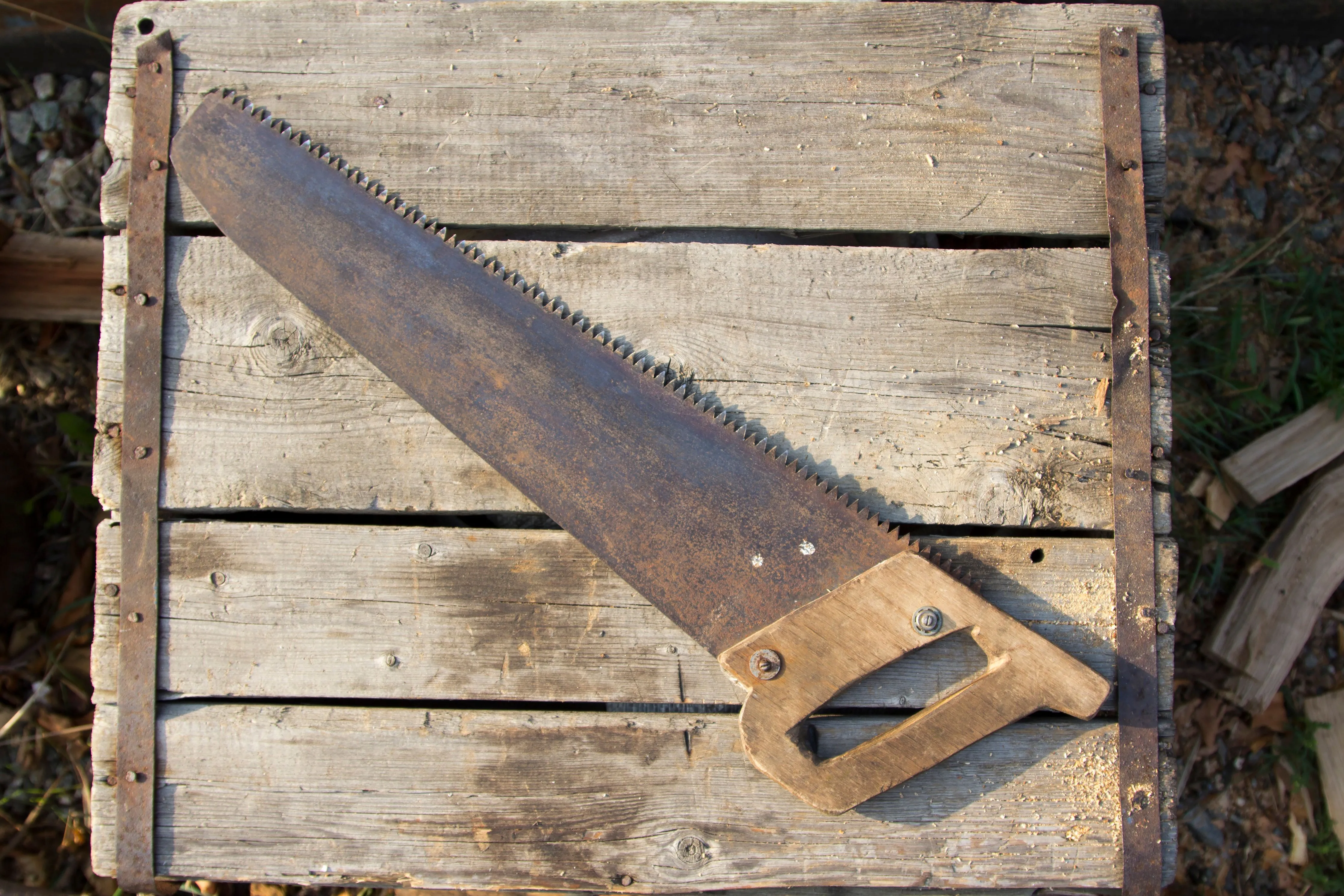
Most people who find an old hand saw find a Disston. Henry Disston and Sons dominated American saw manufacturing from roughly the 1840s through most of the twentieth century, and their saws are still highly regarded for actual use.
Dating a Disston comes down to the etch on the blade and the handle medallion. The “eagle and shield” medallion on the handle changed in style over the decades. Pre-1900 Disstons typically have a more ornate handle with finer carving. The etch (the decorative acid-etched design on the blade near the heel) evolved through several distinct periods.
The diamond-logo era Disstons — those with a prominent diamond device in the etch — are particularly prized by collectors. Early examples with fine etch detail and good etch survival are worth real money. A late-production Disston with a barely visible etch is still a great saw but not a collector’s piece.
Atkins was Disston’s main American competitor. Their saws are less well-known but just as well-made and often found at lower prices. Look for the “Silver Steel” designation on good Atkins examples — it indicates their premium blade steel.
E.C. Atkins of Indianapolis and the Simonds Saw Company are the other names you’ll see on quality American saws. Richardson saws are less common but well-regarded. If you find a saw with a city like Sheffield, England on the blade, you’re looking at a British import.
Handle style dates saws effectively. Open handles (no closed grip) are characteristic of older designs. The specific profile of the closed handle changed over decades in ways that specialists can read. Beech was the most common handle wood, with applewood and rosewood used on premium models.
Spoke Shaves and Draw Knives
Most people who find a spoke shave or draw knife have no idea what they’re looking at. That’s understandable — these are chairmaking and coopering tools, and neither industry exists at any meaningful scale today.
A spoke shave is a small two-handled cutting tool used for shaping curved surfaces. It looks a bit like a tiny plane with a handle on each side. They were used for shaping wheel spokes, chair legs, and any curved surface that needed smoothing. Stanley made them (the No. 51 flat-faced and No. 52 round-faced are the most common), as did dozens of other manufacturers.
Dating a spoke shave is mostly about the blade adjustment mechanism. Early ones used a simple wedge. Later ones had threaded adjustment screws. The quality of the casting and japanning follows the same timeline as planes.
A draw knife is the larger, two-handled blade used with a pulling motion for rough shaping of wood. Finding a draw knife means someone near you used to do chairmaking, coopering, or timber framing. Old draw knives with their original handles intact are genuinely useful tools that can still be put to work. Identifying the maker is usually difficult since most weren’t prominently marked.
Coopers’ and Specialty Trade Tools
These are the truly stumping ones. Coopering — the trade of making barrels and casks — used a suite of specialized tools that most people today have never seen and wouldn’t recognize.
The cooper’s croze is a grooving plane that cuts the groove near the end of stave barrels where the head fits. It looks like a router plane gone sideways, with an adjustable fence and a curved blade. If you find one, it’s a genuine antique from a dead trade.
The traveler (or wheel traveler) is a rolling measuring tool — a small wheel on a handle — used to measure the circumference of barrel heads and wheel rims. It looks like a toy of some kind and stumps almost everyone who finds one.
Wheelwrights’ tools are similarly opaque. A spoke dog, a felly clamp, a tire bender — none of these would mean anything to most people today. If you find something that looks like a specialized clamp or forming tool and can’t figure out its purpose, there’s a good chance it’s from a trade that no longer exists in its historical form.
For these mystery tools, a photo posted to the Oldtools mailing list or r/vintagetoolcollecting will usually get an identification within hours. The communities that care about these things are small but extraordinarily knowledgeable.
Is This Tool Worth Anything?
Honest answer: maybe, but probably less than you think, and sometimes much more.
The most valuable vintage tools share a few characteristics. They’re from the right manufacturer during the right production period. They retain their original finish, hardware, and components. They’re in good condition — not necessarily “mint,” but not heavily damaged, re-ground, or refinished. And there’s collector demand for that specific model.
What’s genuinely rare and valuable:
A Stanley No. 1 smoothing plane in original condition with good japanning and original tote and knob is a $800–$2,000 tool depending on type and condition. There were so few made relative to other sizes that finding one at an estate sale at any price would be significant.
A very early Stanley No. 45 combination plane — the first type, pre-1885 — with original cutters and the original box is a serious collector piece. The No. 45 stayed in production for decades, so most examples are common later types. But the earliest versions are distinct and valuable.
Early Disston saws with excellent etch survival, in original condition, from the diamond-logo era (roughly pre-1880) are genuinely collectible. The difference between a saw with a clear, beautiful etch and the same saw with a worn-off etch is significant both aesthetically and monetarily.
Pre-1860 wooden-bodied planes from known regional makers, particularly ones with original blades and wedges, are of interest to serious collectors of early American tools. Condition and provenance matter enormously here.
What’s common but still beloved:
A Stanley No. 4 Type 11 (made roughly 1910–1918) is not rare, but it’s a genuinely excellent smoother that serious woodworkers want. “User grade” condition — meaning the tool works well but shows honest use — is still worth $40–$80 to the right buyer. A collector-grade example in excellent original condition brings more.
A Disston D-8 panel saw in decent shape will always find a buyer among woodworkers who want to use it. These are the workhorses of vintage saw collecting — common, affordable, genuinely good tools. Same goes for a Stanley No. 5 jack plane, a good brace from Millers Falls, or a Yankee screwdriver that still works.
The user grade vs. collector grade distinction:
“User grade” means the tool has been used, possibly refinished or modified, but is still fully functional. These are tools that woodworkers buy to put to work. “Collector grade” means original condition — original finish, original parts, original labels if applicable. Collector grade tools command a significant premium over user grade.
A plane that’s been taken apart, cleaned, and refinished may be functionally better than it was — but it’s less valuable to a collector than a dirtier but untouched original. If you find something that might be valuable, don’t clean it until you know what you have. The “doorstop that turned out to be a $400 plane” scenario is real, and it goes in the other direction too: plenty of people have scrubbed and polished their way through any collector value a tool might have had.
Using AI to Identify Vintage Tools
AI-based tool identification has gotten genuinely useful for old tool identification, and it’s worth understanding what it handles well and where it still struggles.
For the mainstream vintage tools — Stanley bench planes, common Disston saws, standard braces and bits, egg-beater drills, spoke shaves — AI image recognition does well. If you photograph a Stanley No. 4 from a reasonable angle showing the body, tote, knob, and frog area, a good AI identification tool will recognize it correctly most of the time. Same with common Disston saws if the etch or handle medallion is visible.
Where AI still has trouble is with the outliers. Very early type variants where the distinguishing features are subtle casting details. Completely unmarked tools where even human experts disagree. Obscure regional manufacturers who operated for a few years and left almost no documentation. Pre-industrial hand-forged tools where variation was the rule. Trade-specific tools from dead industries.
For those situations, a photo is still your best starting point — but you should expect to supplement it with text description. Describing what you see: the construction method (forged vs. cast), the adjustment mechanism if any, the approximate size and weight, the material of any handles or working surfaces, any partial markings — all of that feeds additional identification logic that can work where pure visual recognition gets stuck.
The other thing AI does well is narrowing the field. Even if it can’t give you a confident answer on a mystery tool, it can usually tell you what category of tool you’re looking at, which era it’s likely from, and what it was probably used for. That’s often enough to point you toward the right community or reference to get a definitive answer.
What AI definitely can’t do yet is the nuanced type study work — distinguishing a Stanley Type 9 from a Type 10 by subtle casting differences, or identifying the specific production year of a Disston based on the exact style of the medallion engraving. That work still requires human expertise and a good reference library.
When You’re Really Stuck
Some tools will stump everyone on the first pass. Here’s where to go when the basic approaches don’t work.
Patrick Leach’s “Blood and Gore” is the definitive online type study for Stanley Bailey planes. It’s been online for decades and covers every significant type variation with photographs and detailed descriptions. If you have a Stanley plane and want to date it precisely, this is your first stop. It’s detailed, opinionated, and written with genuine love for the subject.
The Oldtools mailing list has been running since the early days of the internet and has an archive that’s worth mining. The membership includes some of the most knowledgeable vintage tool people in the world, and they genuinely enjoy identifying mystery tools. Post a clear photograph with dimensions and any visible markings, and you’ll get answers.
PATINA (the Plane And Tool Investigation and Naturalist’s Association, yes really) is a collecting organization focused specifically on planes and edge tools. Their publications and membership network are invaluable for serious identification questions.
r/vintagetoolcollecting on Reddit is the most accessible starting point for many people. The community is active, knowledgeable, and generally welcoming to newcomers. Photo quality matters here — good raking-light shots that show markings and construction details will get better responses than blurry snapshots.
Local antique dealers who specialize in tools are underutilized resources. Not every antique dealer knows tools, but in most regions there’s at least one who does, and they’ve usually seen everything. A dealer who runs a regular tool auction will have handled more mystery objects than most collectors.
Tool auctions and meets — Martin J. Donnelly Auctions and Brese Plane are names in the tool auction world, and attending a live tool auction or meet is genuinely educational. You see hundreds of tools and hear collectors talk about them. That accumulated exposure develops the pattern recognition that makes identification faster over time.
For pre-industrial and international tools, the resources get more specialized. The Mercer Museum in Doylestown, Pennsylvania has an extraordinary collection of pre-industrial tools and the staff can be helpful. For British tools, the Tools and Trades History Society publishes excellent research. For measuring tools specifically, the Oughtred Society focuses on slide rules and calculating instruments.
Old tool identification is genuinely its own specialty within the broader world of antiques. The learning curve is real. You’ll make mistakes — misidentify things, pay too much for common pieces, miss rarities you later recognize. Everyone who’s been doing this for any length of time has stories about both.
But the upside is that you get to handle these objects that have survived a century or more of actual use. A plane that cut real wood in a real workshop in 1895. A saw that framed houses long since torn down. These aren’t decorative objects. They’re functional history.
Most mystery tools can be identified with the right approach and the right resources. Some will stump you, and that’s fine — the question is part of the experience. The identification journey is half the point.
And occasionally, the paint-stiffened lump you bought for three dollars turns out to be something genuinely worth knowing about. That’s reason enough to keep looking.
Get Tool Insights Delivered
Join 10,000+ tool enthusiasts receiving expert tips, buying guides, and exclusive tool identification insights.
We respect your privacy. Unsubscribe anytime. Read our Privacy Policy .